
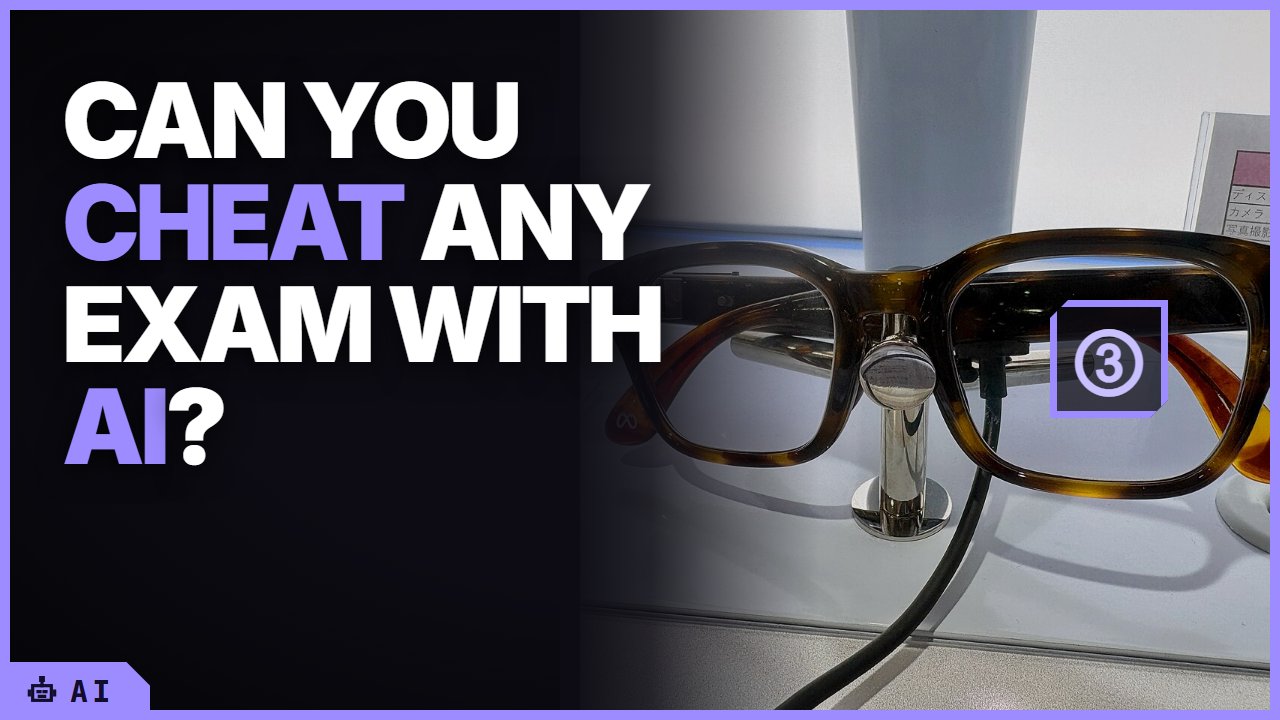
Can you cheat any exam with AI now? In South Korea, one man came very close to proving it.
On the national tax accountant exam, he got 159 out of 160 questions right. In one subject, the average was 30 out of 100. Everyone blamed AI glasses. It wasn't the glasses.
If it worked on one of the country's hardest exams, which exam is safe?
One mistake in 160 0:30
This spring, 16,856 people took the first round of South Korea's tax accountant exam.
| Top scorer | Everyone else | |
|---|---|---|
| Total score | 397.5 / 400 (159 of 160 right) | fewer than 1 in 5 passed the round (18.09%) |
| Introductory tax law | 100 / 100 | average 30.18; 74.21% scored below the minimum of 40 |
| Time | 80 minutes for 80 questions | about one minute per question, including marking the answer |
Source: The Korea Herald, November 13, 2026.
He also got perfect marks in accounting and commercial law. Other candidates and some tax accountants asked the obvious question: is that even possible?
To be fair, brilliant scores do happen. The Korean Association of Certified Tax Accountants warned that "exceptional scores alone should not be grounds for suspicion." And the two proctors in the room hadn't reported anything strange.
But online, people already had a suspect. A pair of glasses.
The 18-minute test 1:32
Why glasses? Because a few months earlier, someone had shown that they work.
In June 2026, Korea JoongAng Daily reported on a tech YouTuber called Techmong. He put on AI glasses with a camera and took a practice math test for Korea's college entrance exam. He looked at each question, and the answer showed up on the lens in under thirty seconds. 30 questions. 18 minutes. 96 out of 100.
Schools panicked. Some started borrowing metal detectors. A teacher pointed out the problem: current detectors can't pick up titanium or plastic.
And the cases kept coming:
- May: two people were caught wearing AI glasses on the TOEIC English test (The Korea Times).
- This year: the Education Ministry found students at four schools using them on exams. One kept touching his frames. Another was given away by a green light reflected in the lenses.
- October 3: at the University of Seoul, a proctor noticed a candidate's glasses looked "unusually thick." They were AI glasses. The candidate was applying to the AI department, where 120 people were competing for five places (The Korea Herald, citing MBC).
So when the tax exam results looked impossible, everyone pictured the same thing.
How AI glasses cheat 2:50
From the outside, AI glasses look like ordinary thick-framed glasses. Inside the frame there's a tiny camera, a microphone and a battery. Some also have a tiny display in the lens.
In general terms, the chain looks like this:
- The camera takes a picture of what you're looking at.
- The glasses send it, without a cable, to the phone in your pocket.
- The phone sends it to an AI model, like a free chatbot. Today's models can read a photo: they read the question, solve it and send back an answer.
- The answer appears on the lens. You never look down. You never touch your phone.
In other words, the person taking the test isn't the one solving it.
It's not just Korea. In 2024, an 18-year-old in Japan used camera glasses on Waseda University's entrance exam and paid people online for the answers (The Japan Times). In China, Tencent, Alibaba, ByteDance and Moonshot switched off some AI features during the national college exam (Fortune). And in the United States, the College Board banned smart glasses on the SAT (The Korea Times, citing Inside Higher Ed).
A country hunts for glasses 3:51
The big test was coming on November 19: the Suneung, Korea's college entrance exam. About eight hours long, and for many students it decides where they study. The Korea Herald reported that 551,864 people applied this year, at 1,312 test centers.
In October, the Education Ministry announced that proctors would inspect every pair of glasses before each session. Wearing smart glasses, even switched off, voids the exam.
People took it seriously. One office in Busan got dozens of calls in a single day from test-takers asking if they should change their frames. An 18-year-old named Jin told Korea JoongAng Daily: "I've always worn these glasses, but now I'm worried someone might question them."
The plan was simple. Find the glasses, stop the cheating. And then, four days before the exam, the top scorer spoke.
Sunday, the confession 4:41
On Sunday, November 15, a fourteen-minute video went up on his lawyer's YouTube channel. He wore a mask. Fortune reported it passed 1.5 million views.
His first words, as reported by The Korea Times: "I cheated on the tax accountant examination."
And that's the twist. It wasn't the glasses. In his words, he used "a miniature camera to photograph the exam questions, sending them to AI." He declined to share further details so others could not copy the method.
Korea JoongAng Daily added what police found: a small screen that mirrored his phone, and a modified calculator. According to police, he didn't use smart glasses or earbuds.
He admitted doing the same on the first stage of the national CPA exam. Why? "I wanted to make money, and I hated seeing myself disappoint my parents after leaving a good job," he said.
| Date | What happened |
|---|---|
| Nov 13 | The Korea Herald reports the scores and the suspicions |
| Nov 15 | The confession video |
| Nov 17 | He walks into a Seoul police office with his lawyer |
| Nov 19 | Suneung day |
The exam agency, HRD Korea, apologized "for failing to prevent cheating as the examination administrator." Before the confession, it had said it found no concrete evidence. Fortune and The Korea Times reported that the Ministry of Economy and Finance moved to revoke his qualification. The investigation is still open.
So if the cheat wasn't in the glasses, where could it be?
A $45 camera 5:44
Almost anywhere. Glasses sit on your face, where a proctor can see them. A camera that small fits in a button, a pen, an eraser.
Korea JoongAng Daily found tiny cameras with earphones sold online for about 60,000 won, around $45. One seller even explained how to hide the battery.
Remember the pass rate? Fewer than one in five made it through that first round. Years of study for everyone else. About $45 of hardware for one candidate.
And the AI didn't need the glasses. It needed one thing: a clear photo of a multiple-choice question.
What an exam is for 6:21
So, can you cheat any exam with AI now?
Our conclusion: almost any exam that only checks the final answer can be beaten by a cheap camera and an AI, if nobody finds the device. The glasses were never the real weak spot. The exam was.
Kim Byung-chan, a professor at Kyung Hee University's graduate school of education, put it this way to Korea JoongAng Daily: "Examinations should assess not only the final answer but also the thought process."
Some Korean educators go further: questions an AI can't answer, or tests where you're allowed to use AI and judged on how you use it.
Check everything 7:04
For now, Korea is trying the other way: check everything. Two days before the Suneung, it added 8,400 proctors. Glasses, clothes and belongings get checked, and buttons on students' clothes get covered with stickers, because cameras can be disguised as buttons.
On exam morning, at 8:30 a.m., every phone in the country sounded a ten-second test alarm, the highest alert level, the kind that can't be silenced even in silent mode.
The result, reported by The Korea Herald from the Education Ministry: 22 hidden smartphones detected across nine cities and provinces. No AI glasses. No miniature cameras. At least, none found so far.
You might be thinking: so it worked. Teachers aren't so sure. The Korean Federation of Teachers' Associations criticized the "heavy reliance on visual inspections" and warned that teachers could be blamed for anything they miss.
Here's what we can't stop thinking about. A glasses check catches glasses. A button check catches buttons. Every rule catches yesterday's device.
Why this matters beyond students
A license is a promise. When you hire a tax accountant or see a doctor, that exam is how you know they actually know. In this case, the exam agency hadn't found any evidence. What ended the story was his own confession.
My conclusion 8:15
One mistake in 160. A camera that costs about $45.
Can you cheat any exam with AI now? Today, almost. That's why the exams are about to change, not just the glasses.
Should exams ban AI completely, or be rebuilt around it? Tell us in the comments on YouTube.