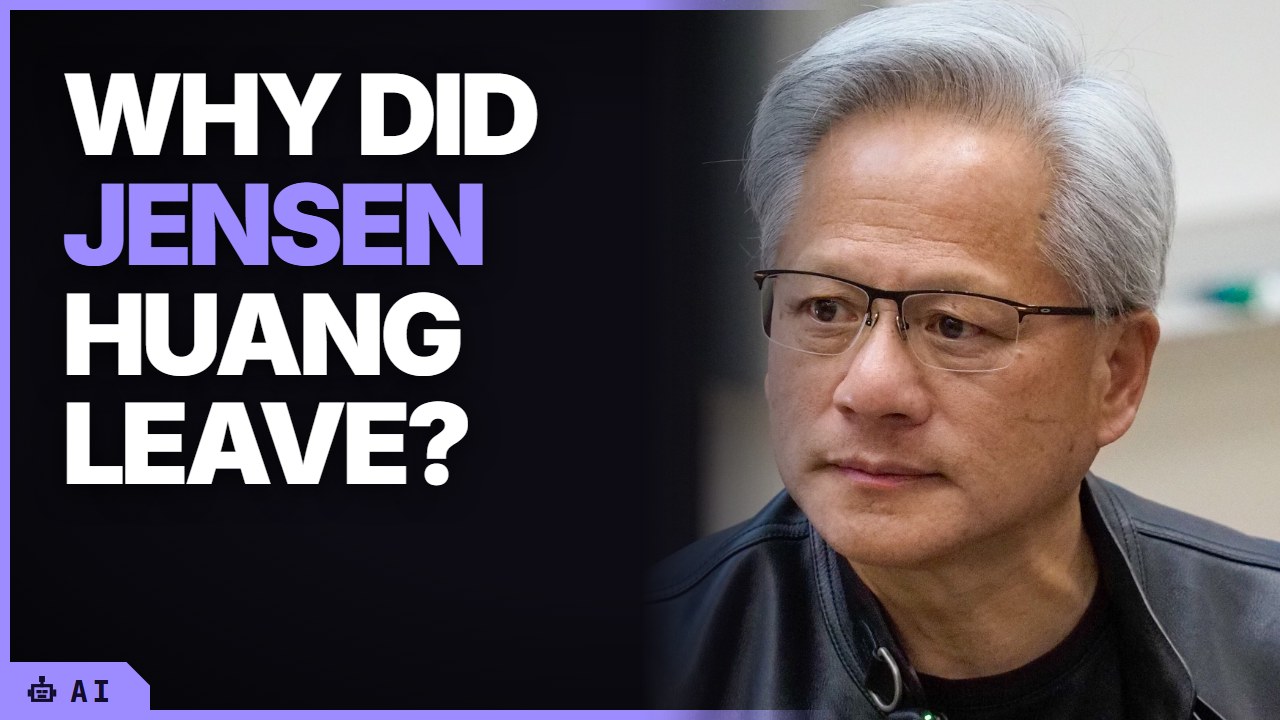
On Thursday, November 12, 2026, Nvidia filed a short document with the U.S. regulator. It said Jensen Huang "has resigned as President, Chief Executive Officer, and a member of the Board, effective immediately." That was it. No reason.
Four days earlier, on Sunday, the board had said it was standing by him. By Thursday, the man who built the world's most important AI company was gone.
So what happened in those four days?
The man in the leather jacket 0:23
First, why this matters. Nvidia makes the chips that almost every big AI system runs on. ChatGPT, Gemini, Claude: most of them were trained on Nvidia hardware.
And for thirty-three years, one man ran it. Jensen Huang co-founded Nvidia in 1993 and became the face of the AI boom, always on stage in the same black leather jacket.
The story also has a price tag. CNBC reported on November 13 that Nvidia's stock had fallen six weeks in a row, its longest losing streak since 2012: about $1.7 trillion in value, gone.
The woman from Singapore 1:09
Her name is Alice Huang. No relation to Jensen.
She used to run Megaspeed, a company based in Singapore. Fortune reported that Megaspeed became one of Nvidia's biggest buyers in Southeast Asia.
- June 2024: the first known photo of the two, sitting side by side at Computex in Taipei, Asia's biggest tech show (ABC News).
- May 2025: a Taiwanese TV channel filmed them leaving a restaurant together in Taipei.
- June 2025: according to CBS News, Singapore took the passport of Alice Huang, then Megaspeed's CEO, and kept it for eight months. The investigation was about servers full of Nvidia chips, and whether false declarations were made when they were bought.
She was never charged in Singapore, but CBS reported she was barred from ever returning. Megaspeed says she left the company in 2025, and denies any wrongdoing.
Why chips and China matter so much
The United States limits which AI chips can be sold to China. The most powerful ones are off limits. So if someone could quietly route them there, that would be worth billions. That is the suspicion around the servers: suspected, not proven.
Then came the biggest claim. The New York Times reported that U.S. officials had concluded Alice Huang was a Chinese intelligence asset. In other words, a spy. China's foreign ministry called that "completely groundless" and "pure slander".
What the White House knew 2:38
Here's where it gets strange. ABC News published a timeline, based on its sources, of what the White House was told and when:
- Fall 2025: President Trump was first briefed on the relationship. He didn't act.
- December 8, 2025: Trump announced that Nvidia could sell one of its powerful chips, the H200, to China, with the U.S. government taking a 25% cut.
- May 2026: Secretary of State Marco Rubio warned Trump again, on Air Force One. The next day, Huang stepped off Air Force One in Beijing, on Trump's trip to China.
- October 8, 2026: Trump gave Huang a national medal for science and technology.
Warned twice, according to ABC's sources. And then, a medal.
Three weeks later it all became public. On October 29 the New York Times reported a "close relationship" between the two. Two days later, the Wall Street Journal reported that intelligence officials in several countries suspected she might be a spy.
The four days 3:38
| Day | What happened | Reported by |
|---|---|---|
| Sunday, Nov 8 | Huang sends a memo to staff admitting he was unfaithful to his wife, and apologizes. The board opens an independent investigation, says it has no reason to believe national security or company secrets were compromised, and keeps him. | Washington Post, Axios, TechCrunch |
| Monday, Nov 9 | China denies everything. Trump says Huang told him by phone he had no idea she was a spy. | ABC News |
| Tuesday, Nov 10 | Congressman Brian Mast, chair of the House Foreign Affairs Committee, says he is ready to subpoena Huang if he won't answer questions. | ABC News |
| Wednesday, Nov 11 | The New York Times reports a second relationship, with a senior Nvidia executive who reported directly to him. That night the Wall Street Journal reports the board plans to push him out. The stock sinks after hours. | NYT, WSJ, Axios |
| Thursday, Nov 12 | Nvidia's filing: he has resigned, effective immediately. | Nvidia (SEC filing) |
Nvidia, Huang and the executive have not confirmed the second report. We don't name her: she is not a public figure.
Why the second story mattered more 4:39
You might be thinking: so it was the spy.
But look at the timeline again. The spy story was public for almost two weeks, and the board stood by him through all of it. What changed at the end was the second story.
Dates: The New York Times (October 29 and November 11, 2026), as cited by ABC News and Axios; Nvidia Form 8-K (November 12, 2026).
Here's why. An affair is a personal problem. A relationship with someone who reports to you is a company problem: that person's pay, promotions and job depend on you. So many big companies treat it as a breach of their rules, even when both people say it was consensual.
It has happened before:
- Intel, 2018. The CEO resigned over a past relationship with an employee. Intel called it "a violation of Intel's non-fraternization policy, which applies to all managers", and named its finance chief interim CEO. Sound familiar?
- McDonald's, 2019. The board pushed out its CEO for a relationship with an employee, saying he "violated company policy and demonstrated poor judgment".
And that's what CNBC heard too. According to a person familiar with the matter, sentiment on Nvidia's side "quickly turned after the report of a second alleged affair."
Quick recap: a woman U.S. intelligence reportedly suspects of spying for China, a board that backed him anyway, and a second story that ended it in four days.
The trillion-dollar problem 6:12
Here's the twist most headlines skip: Nvidia's stock was falling before any of this. CNBC reported that investors had turned against it weeks earlier, worried that rising interest rates would hurt AI companies that run on borrowed money. Over six weeks, Nvidia lost about 30% of its value.
So the scandal didn't start the fall. It landed on a stock that was already bleeding.
On the day he left, the stock hit its lowest point in a year early in the day. By the close it had recovered to a loss of about 4.3%. Fear first, then second thoughts. Investors call that fear key person risk: when a company's value leans on one person, losing that person is a risk on its own.
The board moved fast to calm it. Colette Kress, Nvidia's finance chief, became interim CEO and keeps her old job too. Her first big test: Nvidia's quarterly results on November 17, the first without Huang. The question on Wall Street is simple: can Nvidia keep winning without him?
What we still don't know 7:22
Four big questions are still open:
- Did any chips reach China? CNBC, citing Semafor, reported that the Justice Department is looking into whether organizations tied to Alice Huang helped divert AI servers made by Super Micro, which are packed with Nvidia chips, to China.
- Did any secrets leak? Nvidia's board says it has no reason to think so. Nobody has shown otherwise in public.
- What will Congress ask him? Congressman Mast says Huang has agreed to testify before Thanksgiving, and Senator Tim Scott wants him before the Senate Banking Committee on December 3.
- Who replaces him? President Trump already has an idea. He wrote that there is "only one man to take his place": Tim Cook, of Apple.
And one thing matters a lot here. Fortune reported that neither Jensen Huang nor Nvidia has been formally charged with any wrongdoing. And Singapore never charged Alice Huang.
My conclusion 8:31
Jensen Huang survived the spy story. For almost two weeks, the board stood by him. What ended it was a second story, about someone who worked for him, landing on a stock that had already lost a fortune.
Two weeks of the spy story, and he stayed. One day after the second story, he was out.
So why did Jensen Huang suddenly leave Nvidia? Because the spy story made him a risk, and the second story made him impossible to defend. That's our reading of the public record; Nvidia itself still hasn't given a reason.
What do you think really ended it: the spy story, or the second story? Tell us in the comments of the video.