
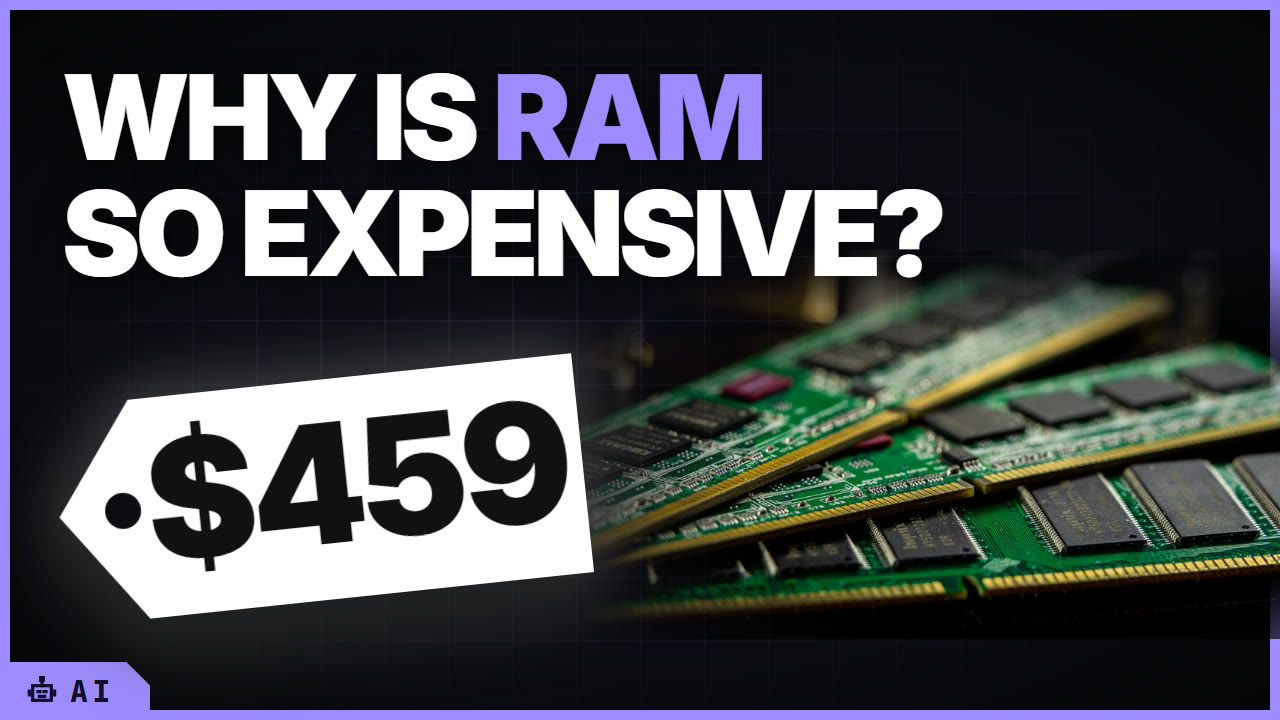
In December 2025, Micron, one of the three companies that make most of the world's memory, made a strange announcement: it would stop selling memory to regular people. Its own press release gave the reason in one line. The AI-driven growth in the data center had led to a surge in demand for memory and storage, so Micron would put its larger, strategic customers first. In plain words: the AI companies.
Two months later, TrendForce, a firm that tracks memory prices, said contract prices for regular memory chips would jump 90 to 95% in a single quarter, and more than 100% for PC memory. A new record. In other words, the price manufacturers pay for the memory inside a computer doubled in three months.
And somebody is winning. Samsung's own quarterly report shows an operating profit of 107.4 trillion won, about $80 billion, in just three months. It's the first tech company in the world to pass a hundred trillion won in a single quarter.
So why is RAM so expensive right now? And when will it get cheaper?
What RAM actually is 1:44
Your computer has two kinds of memory.
- Storage is the closet. It's where your files, photos and apps live, even when the power is off.
- RAM is the desk. It's where your computer puts whatever it's working on right now. The bigger the desk, the more you can do at once. When it's full, everything slows down. And when you turn the power off, the desk is wiped clean.
It's not only in computers. Your phone has RAM. So does a game console, a smart TV and a car. Almost anything with a chip needs some.
Here's the first surprise: almost all of it comes from just three companies. Samsung and SK hynix, in South Korea, and Micron, in the United States.
Source: Counterpoint Research, global DRAM market share, Q3 2026 (November 5, 2026).
Last quarter, those three made 88% of the world's RAM, according to Counterpoint Research. A Chinese company, CXMT, made most of the rest. So when those three change their plans, the whole world feels it.
Where the memory went 2:51
Their plans changed because of AI.
An AI model like ChatGPT runs on special chips, mostly made by Nvidia. Those chips do math incredibly fast, but they're only as fast as the memory that feeds them. So right next to each AI chip sits a special kind of RAM called HBM, high bandwidth memory. Picture memory chips stacked on top of each other like a sandwich, placed right beside the processor, so the data barely has to travel.
Nvidia's newest AI chips carry 288 GB of it, each. Many laptops come with 16. And a single AI data center can hold tens of thousands of those chips.
One oven, two kinds of orders
HBM and the RAM in your laptop come out of the same factories, made on the same silicon discs, called wafers. A wafer is a thin plate of silicon, about the size of a dinner plate, that gets cut into hundreds of chips. Every wafer a factory makes has to become one or the other: laptop memory, or AI memory.
And AI memory is hungry. Micron estimates that HBM uses about three times as much wafer as regular memory for the same amount of memory. In other words, every gigabyte that goes to an AI chip is roughly three gigabytes your laptop doesn't get.
Think of a bakery with one oven. It can bake bread or wedding cakes. A wedding cake takes three times the oven space, but it pays a lot more, and the customer orders a year ahead. So the baker fills the oven with cakes. There's less bread, and the bread that's left gets expensive.
That's the RAM market right now. You're the bread.
And the cake customers keep ordering. SK hynix told investors in October 2026 that it expects demand to stay above supply through 2030.
Why they don't just build more factories 4:59
If they're making so much money, why don't they just build more factories?
Because a memory factory is one of the hardest buildings on Earth to make. Micron's own annual report shows it: construction of its new factory in Idaho began in October 2023, and the first memory is expected around the middle of 2027. Almost four years.
There's a second reason: memory makers have been burned before. This industry swings between boom and bust. When prices are high, everyone builds. Then too much memory arrives at once, and prices crash. It happened in 2023: prices collapsed, the makers lost money, and they cut production.
So now they build carefully. They'd rather sell less memory at a high price than flood the market and crash it again.
Quick recap: three companies make almost all the RAM, AI memory eats about three times the wafer, and new factories take years.
What it means for you 6:13
Start with the RAM itself. Tom's Hardware tracks memory prices every week. The cheapest a 32 GB desktop kit ever got was $72. On November 3, 2026, the same kind of kit cost $459. That's more than six times as much.
Source: Tom's Hardware, RAM price index (updated November 3, 2026).
And it's not just for people who build computers. It's inside things you already buy:
- PlayStation 5: Sony raised it from $549.99 to $649.99 in April 2026.
- Nintendo Switch 2: from $449.99 to $499.99 in September 2026.
- Xbox: Microsoft said the memory and storage inside its consoles now cost more than two and a half times what they used to.
So people stopped buying. Worldwide, computer sales fell 20% in the third quarter of 2026 compared with a year earlier, according to preliminary data from IDC: about 62.7 million computers, down from 78.5 million.
Even the people at the top are fighting about it
On the Cheeky Pint podcast in late October, OpenAI's CEO, Sam Altman, said it's "quite terrible" for so much of the world's limited memory to sit in people's own computers. Elon Musk answered on X: "The people deserve to have their RAM too!" Altman later said he does want people to have tons of memory.
But the fight says it all. Your computer and the AI companies are now bidding for the same chips.
When will RAM get cheaper? 7:51
Not this year. TrendForce expects memory contract prices to rise again in the last three months of 2026: more slowly than before, but still up about 20%.
The makers themselves see a long road. Samsung expects memory to stay tight through 2028; SK hynix, through 2030.
Not everyone agrees. Acer's CEO, Jason Chen, says the memory makers keep warning about long shortages to protect their profits. He expects prices to start falling in the second half of 2027, as cheaper Chinese memory from makers like CXMT keeps coming.
That doesn't mean a crash. Even when the new factories open, AI will still be first in line.
My conclusion 8:44
RAM isn't expensive because the world forgot how to make it. It's expensive because your computer is now bidding against AI, and AI pays more.
The price manufacturers pay for PC memory doubled in a single quarter, and Samsung made about $80 billion in three months. For the first time, the biggest customer for memory isn't you. It's AI.
Who do you think should get the memory first: AI data centers, or people's computers? Tell us in the comments of the video.