Here's something nobody tells you when you get a raise: you can earn more money this year than last year and still be poorer.
Not because you spent too much or made a bad decision, but because of a quiet force that takes a little of your money every day without ever touching your bank account. It's called inflation. This guide explains how it works, who wins from it, who loses, and what people do so they're not on the losing side.
What inflation actually is 0:49
Inflation is not prices going up. That's the symptom. Inflation is your money losing power.
A $100 bill is just paper. What it's really worth is what it can buy. If last year it filled a grocery cart and this year it only fills most of that cart, the bill didn't change. Its power did.
Economists measure this with the Consumer Price Index (CPI): a giant basket of things ordinary people buy, such as food, rent, gas, clothes and transport. Every month, government statisticians check what that basket costs. If it costs 3% more than a year earlier, inflation is 3%.
Three percent sounds tiny. As you'll see below, it isn't.
$100 in 2000 vs today 1:47
Here are real average U.S. prices from the Bureau of Labor Statistics, September 2000 against September 2026:
| Item | Sep 2000 | Sep 2026 | Change |
|---|---|---|---|
| Eggs, dozen | $0.92 | $2.27 | ×2.5 |
| White bread, pound | $0.92 | $1.83 | ×2.0 |
| Regular gas, gallon | $1.58 | $4.48 | ×2.8 |
| Ground beef, pound | $1.58 | $6.79 | ×4.3 |
| Bananas, pound | $0.49 | $0.66 | ×1.3 |
| Whole CPI basket | $100 | $194 | ×1.94 |
Put the other way around: a $100 bill today buys roughly what $52 bought in 2000.
Source: U.S. Bureau of Labor Statistics, average retail prices and CPI-U (via FRED).
Notice that not everything rose at the same speed. Ground beef more than quadrupled; bananas barely moved. That's one reason inflation often feels worse than the official number: the official number is an average, but nobody buys the average. You buy your own groceries, and if they're heavy on the items that rose fastest, your personal inflation is higher.
Why inflation happens 2:58
There are three main causes, and the third is the sneakiest.
- Too much money chasing too few things. When governments and banks put a lot of new money into the economy, people have more to spend. If factories can't produce more just as fast, sellers raise prices. More money, same amount of goods: each dollar is worth less.
- Things get more expensive to make. When oil, energy or raw materials cost more, companies pay more to produce and ship everything, and they pass that cost on to customers.
- Expectations. If everyone believes prices will rise, workers ask for higher pay and companies raise prices in advance. The belief becomes reality.
Shrinkflation: same price, less product 3:57
There's a version of inflation that doesn't change the price at all. It's called shrinkflation: you pay the same and get less.
In 2016, the maker of Toblerone shrank the bar sold in the UK from 400 grams to 360 by widening the gaps between the triangles. The box looked the same. The company blamed more expensive ingredients.
It's not just chocolate. A July 2025 report from the U.S. Government Accountability Office (GAO) found that between 2019 and 2024, shrinking packages added about 3 percentage points to the price increase of household paper products such as toilet paper and paper towels, about 2.6 points to snacks and 2.3 points to candy.
For inflation overall, shrinkflation is small: the GAO estimated it at less than a tenth of a point of the 34.5% total rise in that period. But it's the easiest kind to miss.
The Rule of 72 5:05
Here's where small numbers get serious. The Rule of 72 is a quick shortcut: divide 72 by the inflation rate, and you get roughly how many years it takes for cash to lose half its buying power.
| Inflation rate | 72 ÷ rate | Cash loses half its value in |
|---|---|---|
| 2% | 72 ÷ 2 | about 36 years |
| 3% | 72 ÷ 3 | about 24 years |
| 6% | 72 ÷ 6 | about 12 years |
| 10% | 72 ÷ 10 | about 7 years |
So if you saved $10,000 and kept it under the mattress at 6% inflation, twelve years later it would buy what about $5,000 buys today. You didn't lose a single bill, and you still lost half your money.
The same rule works in reverse for growth, which is why it shows up again when people talk about compound interest.
When inflation spins out of control 5:52
Three, six or ten percent is the good scenario. Here's what happens when inflation runs away:
- Turkey: prices rose 85.5% in the twelve months to October 2022, the highest in 24 years (TurkStat).
- Argentina: inflation hit 211.4% in 2023. Prices more than tripled in a single year (INDEC).
- Venezuela: the central bank reported about 130,000% inflation for 2018. Outside estimates, such as the IMF's, were about ten times higher.
What $10,000 in cash buys after one year at those rates:
| Inflation for one year | What $10,000 in cash ends up buying |
|---|---|
| Turkey, 12 months to Oct 2022 (85.5%) | about $5,390 |
| Argentina, 2023 (211.4%) | about $3,210 |
| Venezuela, 2018 (≈130,000%) | less than $8 |
That's why, in places like these, people spend their pay the day they get it or swap it for dollars. When money melts that fast, holding cash is the most expensive thing you can do.
To be fair, Argentina has brought inflation down a lot since: 117.8% in 2024 and about 31.5% in 2025. Even that eats almost a quarter of cash savings in a year.
Why your raise isn't really a raise 7:11
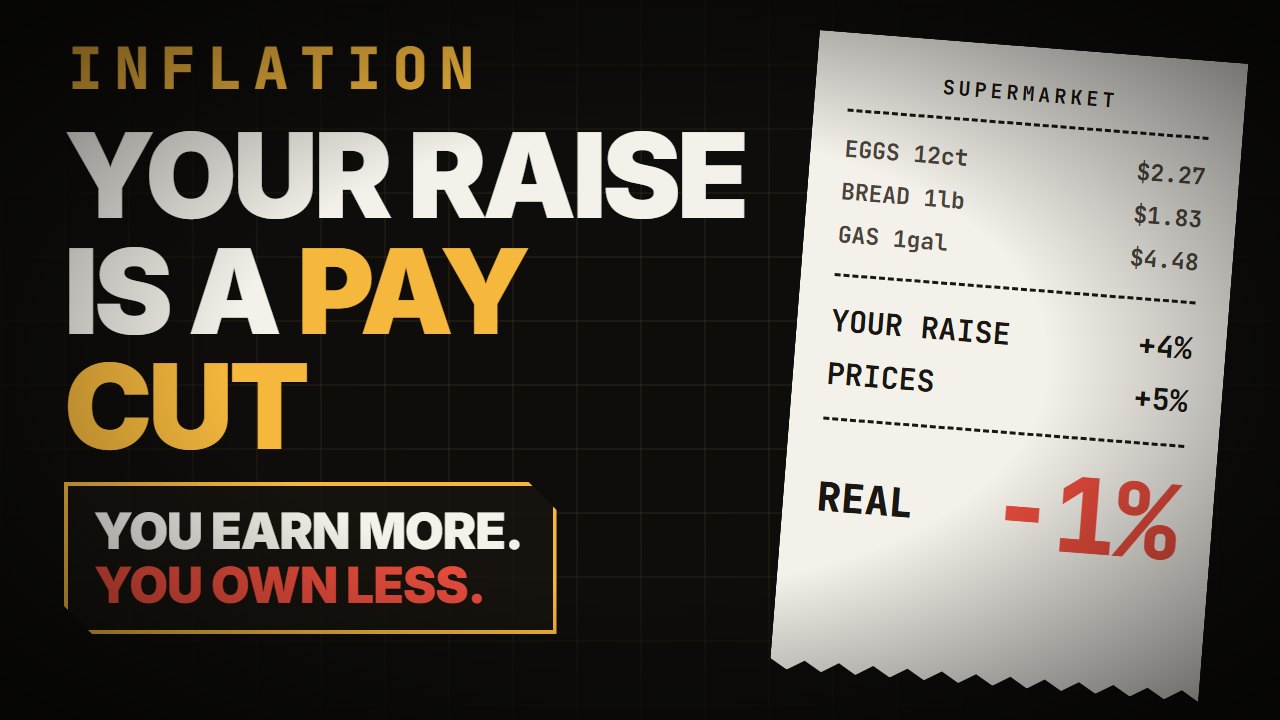
Back to normal inflation, and back to your paycheck. Say you get a 4% raise, and inflation that year is 5%. You just took about a 1% pay cut. The number went up; your life got more expensive faster.
Economists call this the difference between nominal and real income:
- Nominal income is the number on your paycheck.
- Real income is what that paycheck can actually buy.
A quick estimate: real raise ≈ your raise − inflation. The only number that matters for your life is the real one.
Who wins and who loses from inflation 7:48
Inflation doesn't hurt everyone equally. Some people come out ahead.
| Tends to lose | Tends to win |
|---|---|
| People holding a lot of cash | People with fixed-rate debt, which shrinks in real terms every year |
| Workers whose pay adjusts slowly | Owners of real estate |
| Retirees living on fixed savings | Owners of businesses that can raise their own prices |
| Lenders paid back at a fixed rate, in weaker dollars | Shareholders of companies with pricing power |
The big lesson: inflation quietly moves wealth from people who hold money to people who hold assets.
How people protect themselves from inflation 8:40
These are general ideas for understanding the topic. This is education, not financial advice, and everyone's situation is different.
- Don't let all your savings sit as cash. An emergency fund matters. But money beyond that, sitting idle, slowly shrinks. Many people look at options such as high-yield savings accounts or inflation-protected government bonds (in the U.S., TIPS and I bonds) to at least keep pace.
- Learn how ownership works. Historically, over long periods, owning productive assets such as a broad index of companies has tended to beat inflation. Not every year, and not without risk, but over decades owners have generally done better than savers in cash.
- Invest in your earning power. For most people the best inflation hedge is their own skills. A better job, a side business or in-demand skills, such as using AI tools, can make income grow faster than prices.
The bottom line 9:51
The next time your groceries cost more, a package looks a little smaller, or your raise doesn't feel like a raise, you'll know what's happening. Inflation isn't something you can stop. But it's something you can understand, and once you understand it, you can stop being the person who quietly pays for it.