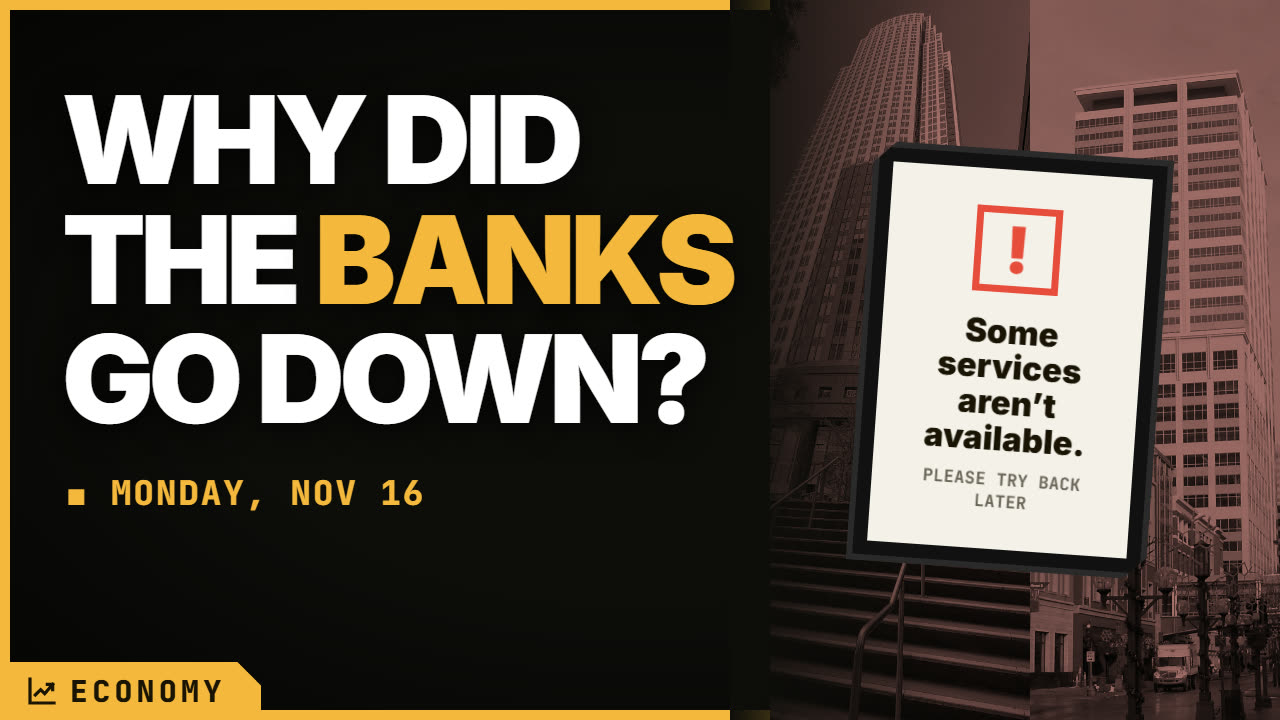
On Monday, November 16, 2026, thousands of Americans opened their banking apps and got nowhere. Some Chase customers saw this on their screens: "Some services aren't available. We're working on them. Please try back later."
Headlines said America's biggest banks were down. Here's the twist: they didn't all go down. One bank had a software bug. And customers at five other banks felt it anyway.
So how can one bug at one bank reach yours?
Monday, 2 p.m.: what happened at Chase 0:19
Chase is the biggest bank in America. JPMorgan, the company that owns it, says it serves 86.6 million consumers and 7.4 million small businesses.
Around 2 p.m. Eastern, according to the news agency AFP, complaints about online banking peaked on Downdetector. People couldn't log in. Payments wouldn't go through.
Then it spread. Customers at Bank of America, Wells Fargo, U.S. Bank, Truist and Capital One reported problems too. ABC7 reported that people at other banks "had problems as they were trying to complete transactions with Chase through Zelle."
Wall Street noticed. Fox Business reported that JPMorgan's stock fell more than 2.4% that afternoon, with Bank of America down over 2.1% and Wells Fargo about 2%.
So what was it? Chase spokesperson Joe Evangelisti told Al Jazeera: "JPMorgan Chase has experienced a temporary issue related to a software bug in an on-premise hardware system – it is not cyber-related." By Monday evening, transactions were posting normally again.
That should have been the end of the story. It wasn't, because of what happened the days before.
Ten days, four failures 1:31
| Date | What failed | Stated cause |
|---|---|---|
| Nov 6 | ATMs and counters at 128 shinkin banks in Japan | "an equipment malfunction, not a cyberattack" (Jiji Press) |
| Nov 12 | Microsoft 365 (Outlook, Teams) for hours | "not related to cyber or AI", an issue from "an earlier network capacity upgrade" (Microsoft) |
| Fri, Nov 13 | Nationwide FAA ground stop, only the second since 9/11 | communication issues; ABC reported a router "that malfunctioned and overwhelmed the aging air traffic control system" |
| Mon, Nov 16 | Chase, felt at five other banks | a software bug, "not cyber-related" (Chase) |
The Japanese case is worth a second look. Jiji Press reported that at about 1:30 p.m. on November 6, ATMs and bank counters stopped working at 128 small regional banks, mostly in western Japan, all at once. Some services stayed down until after 7 p.m. They all ran on the same shared computer system. One equipment failure, and 128 banks went dark together.
On the FAA stop, Homeland Security Secretary Markwayne Mullin said there was no indication of a threat, though, as Gray News reported citing CNN, he did not rule out any possible cause, including a cyberattack.
Is this connected?
A lot of people think so. Videos went viral on TikTok and X claiming a blackout on November 17: 72 hours with no electricity, no internet and no banks. Some even pointed to an episode of The Simpsons as proof. The Spanish tech site Xataka traced the rumor to a mix of unrelated real events.
What was really scheduled that day? A nationwide test of the Emergency Alert System, announced by the FCC two months earlier. The official message says it plainly: "This is only a test. No action is required by the public."
Officials and the companies say these failures aren't related: a broken machine, an upgrade, a router, a bug. Not everyone is satisfied. Jody Westby, CEO of the cybersecurity firm Global Cyber Risk, told Al Jazeera: "I don't think that any of that is a complete explanation the public deserves."
That's a fair point. But here's what bothers us more: they don't need to be connected. The system already is.
Where your money actually is 3:58
Most of your money isn't paper. It's a number in your bank's ledger, the bank's record of who owns what.
When you pay someone, no cash moves. Your bank sends a message: take $50 from this account, add $50 to that one. Two numbers change.
That's what Zelle does. Zelle doesn't hold your money. It's run by Early Warning Services, which is owned by seven big banks, including Chase, and it passes the message from one bank to the other.
Chase is a bridge
Picture Chase as a bridge that millions of payments cross every day: rent to a landlord who banks with Chase, a paycheck from a company that banks with Chase, money to a friend at Chase. If Chase's records slow down, every payment that needs to cross that bridge waits on both sides.
That's what Chase said happened. Its spokesperson told Al Jazeera: "This is not a systemic issue – other banks may have been impacted by slowness in transactions only to the extent that they were a party to a transaction with us."
Your money doesn't disappear
During an outage like this, the number in the ledger is still there. What breaks is your access to it. And if a bank ever failed for real, the FDIC says deposits are automatically insured to at least $250,000 at each FDIC-insured bank.
The few pipes everyone shares 5:23
Most banks don't build their own computer systems. They rent them. A research briefing from the Kansas City Fed found that one company, Fiserv, provides the core system for 42% of banks, and that together with FIS and Jack Henry, the "Big Three" served more than 70% of banks surveyed in 2022. In other words, more than seven out of ten banks lean on the same three companies. Remember Japan: 128 banks, one shared system.
And it's not just banks:
- October 2025, Amazon Web Services. Amazon says a "latent defect" in an automated DNS management system disrupted its cloud for about fourteen hours. Apps from Venmo to airlines went down with it.
- July 2024, CrowdStrike. One bad software update crashed 8.5 million Windows devices, Microsoft said. Banks, airlines and hospitals, all at once.
Look at the pattern: an automated system, an update, an upgrade, a bug. The biggest failures we just walked through weren't caused by hackers. They were ordinary changes that went wrong, in places everyone shares.
When the cards stop 6:55
What happens when it's not a bug, but the power itself? We already know. On April 28, 2025, a blackout hit almost all of Spain and Portugal. The Bank of Spain wrote that electronic payments "simply stopped working," that ATM withdrawals plunged the moment the blackout hit, and that some ATMs ran out of banknotes while others went out of service with cash still inside.
A few months later, the European Central Bank published a study with a title that says it all: Keep calm and carry cash. It notes that authorities in the Netherlands, Austria and Finland suggest keeping about €70 to €100 per person, or enough for essential needs for about 72 hours. The ECB calls cash "a kind of societal insurance, a low-cost safeguard against major systemic instability."
Remember the 72 hours in the viral rumor? That number didn't come from nowhere. It came from real advice about being prepared. The rumor turned it into a prophecy.
America says it too, just more quietly. The government's own emergency checklist on ready.gov lists "Cash or traveler's checks" right there with water and flashlights.
Should you worry? 8:07
Should you take your money out of the bank? No. Taking all your money out makes you a target for theft and earns you nothing. The outage on Monday lasted an afternoon, and the money was there the whole time. What the people who study this recommend is simpler:
- A little cash at home, for a few days of basics.
- A second way to pay, like a card from a different bank, so one bridge closing doesn't stop you.
- Check your bank and official sources before you believe a scary warning that's going viral.
My conclusion 8:46
America's banks didn't all go down. One did, for an afternoon. That was enough to reach customers at five other banks, shake bank stocks, and convince half the internet that a blackout was coming.
One bug, and six banks felt it. Four failures in ten days, and so far none of them blamed on an attack.
How can one bug at one bank reach yours? Because your money doesn't sit still. It travels through a few shared pipes, and when one of them clogs, everyone waits.